
There is a difference between reselling a product and owning a service. Reselling a vendor-branded desktop keeps that vendor visible inside the service experience, at every login, every support screen, every admin console your client touches. White-labelling keeps your brand front and center.
That difference shapes how much control you keep over the client relationship, and it shows up at renewal.
Reselling versus owning the relationship
When you resell a desktop product under the vendor’s brand, the vendor stays visible inside the service. Your client sees whose software it is at the points where they interact with it, which keeps part of the brand relationship, and some of the pricing signal, tied to someone other than you.
White-labelling changes what the client sees. When the desktop, the login, and the console all carry your brand, your brand is viewed across the entire experience. That helps you retain control of the client-facing relationship.
What white-label delivery actually requires
Delivering desktops as a service under your own name has a few practical requirements, and the software either meets them out of the box or it does not.
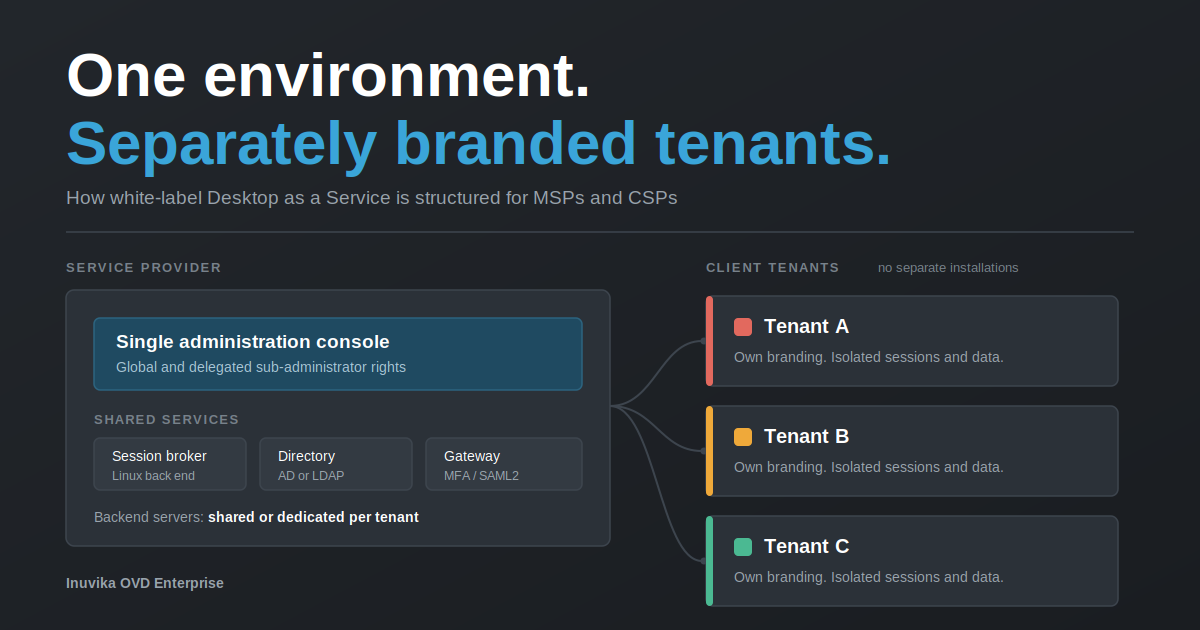
Multi-tenancy without separate installations. Inuvika OVD Enterprise is multi-tenant out of the box. You add new customers as isolated tenants inside one managed environment rather than standing up a separate OVD installation for each. A single click activates multi-tenant mode; from there you assign backend resources, shared or dedicated, according to each tenant’s isolation requirements. Managing many customers from one easy to use multi-tenant environment is what makes a branded service line efficient to run.
Your brand, or your customer’s. OVD Enterprise can be white-labelled quickly with your own or your customer’s corporate branding. You decide whose name the end user sees, per tenant.
One console, delegated control. You manage every tenant from a single web-based console, with global and delegated sub-administrator rights. That means you can hand a customer limited control of their own tenant without giving up control of the environment, and without adding a management product on the side.
Density that funds the margin. Inuvika’s resource containerization lets you host up to twice as many users per server as Citrix or VMware. The same hardware can support more billable users and concurrent sessions across your tenant base, so the economics of a branded service improve as you grow into it rather than straining.
Price Stability and No Vendor Lock-in
Because the customer only knows your brand and your support, the renewal conversation stays with you rather than the vendor. That is the white-label effect.
With all of the upheaval at Citrix and VMware, Inuvika offers calm and predictability. We do not sell directly, so we will never compete for your DaaS customers. Our monthly SPLA model means you only pay for the highest number of concurrent users each month. There are no minimum numbers of users required, so you can flex up and down with seasonal customers and not worry if you lose a customer and your numbers drop. You also avoid vendor lock-in issues if you find yourself in a future situation like the VMware Broadcom price increase for its hypervisior. OVD Enterprise is hypervisor agnostic, so you simply switch to another hypervisor.
Where Inuvika fits
Inuvika OVD Enterprise is a Linux-based virtual desktop and application delivery solution built to be delivered as a service. It offers multi-tenancy out of the box, quick white-labelling under your brand or your customer’s, single-console management with delegated administration, and concurrent-user monthly subscriptions that fit the way a service provider actually bills. Because it is Linux-based, it eliminates most Windows and Microsoft SQL Server licensing that incumbents assume, and it can run on the hypervisor that you already use. It also has built-in multi-factor authentication, allowing you to drop other security apps if you choose. But it is compatible with any SAML2 provider if your client has additional security requirements.
Our MSP Program is built to protect the partner from the unknowns that can be costly: no upfront fees to get started, no minimum number of users, guaranteed pricing for the first three years. This allows you to enter into long term contracts with your customers, knowing that your costs will be consistent. Technical training and certification are free. Service providers including DTS, US Signal, SIMNET, Corporate Technologies, MagicCloud, Insoltec and others already deliver desktops as a service on Inuvika.
If you are building a service line you want to brand as your own, rather than resell, see how the Inuvika MSP and CSP solution supports a white-labelled service, or talk to us about the Inuvika MSP Program.
Frequently asked questions
What is white-label Desktop as a Service?
White-label Desktop as a Service lets an MSP deliver virtual desktops under its own brand while managing multiple customers from a shared OVD environment. Your brand stays front and center across the user and administration experience rather than the underlying vendor’s.
Can we deliver desktops under our own brand rather than Inuvika’s?
Yes. OVD Enterprise can be white-labelled with your own or your customer’s corporate branding, and you choose whose brand the end user sees on a per-tenant basis.
Do we need a separate environment for each customer? No separate OVD installation is required for each customer. Customers are created as isolated tenants within one managed environment, with backend resources shared or dedicated as each tenant requires, all managed from one web-based console with delegated sub-administrator rights.
Are we locked into a hypervisor?
No. OVD Enterprise is hypervisor and cloud agnostic, so it runs on the hypervisor you already use, on-premises or in any public or private cloud. If you find yourself in a future situation like the VMware Broadcom price increase, you simply switch to another hypervisor, including lower-cost options such as ProxmoxVE, VergeOS, and KVM.