

From Microsoft’s latest outage to the global push for digital sovereignty, organizations are rediscovering the value of infrastructure independence. Last week’s Microsoft 365 outage, which disrupted email, collaboration tools, and critical workflows across more than 70 countries for nearly 24 hours, served as a stark reminder of how dependent organizations have become on a handful of technology giants. For hours, IT teams had little choice but to wait for a single vendor to untangle a gateway failure and restore service. The lesson here isn’t that Microsoft is uniquely unreliable. It is a concentration and dependency problem. For over a decade, businesses have been told to move everything to the public cloud, consolidate suppliers, and embrace tightly integrated ecosystems. That convenience comes with a hidden cost: when too many essential services rely on the same provider, a single upstream disruption; or a sudden pricing shift; leaves you with nowhere to turn.
Governments Are Already Rethinking Hyperscaler Dependence
This concern extends well beyond individual enterprises. Around the world, governments are actively building alternatives to reduce reliance on dominant U.S. hyperscalers like Microsoft, Google and Amazon:
- Europe’s Sovereign Cloud Push: France and Germany have championed strict digital sovereignty standards to keep critical data and infrastructure under European jurisdiction. Earlier this year, the European Commission backed that commitment with a €180 million sovereign cloud procurement framework, awarding contracts to European providers including OVHcloud, STACKIT, and Scaleway.
- Canada’s Sovereignty Mandate: In Canada, federal and provincial leaders are similarly prioritizing sovereign cloud capabilities and domestic data residency to ensure public-sector and regulated workloads remain protected under Canadian legal jurisdiction.
These initiatives aren’t about abandoning cloud computing. They are about ensuring organizations retain genuine control over their data, infrastructure, and vendor choices; and that mindset is rapidly spreading into the private sector.
Is On-Premises Making a Comeback?
After years of “cloud-first” mandates, enterprise IT leaders are taking a more pragmatic look at where workloads actually belong. Rising cloud egress and subscription fees, unpredictable licensing changes, data sovereignty laws, and vendor lock-in are driving renewed investment in private infrastructure. Industry data reflects this shift toward balance.
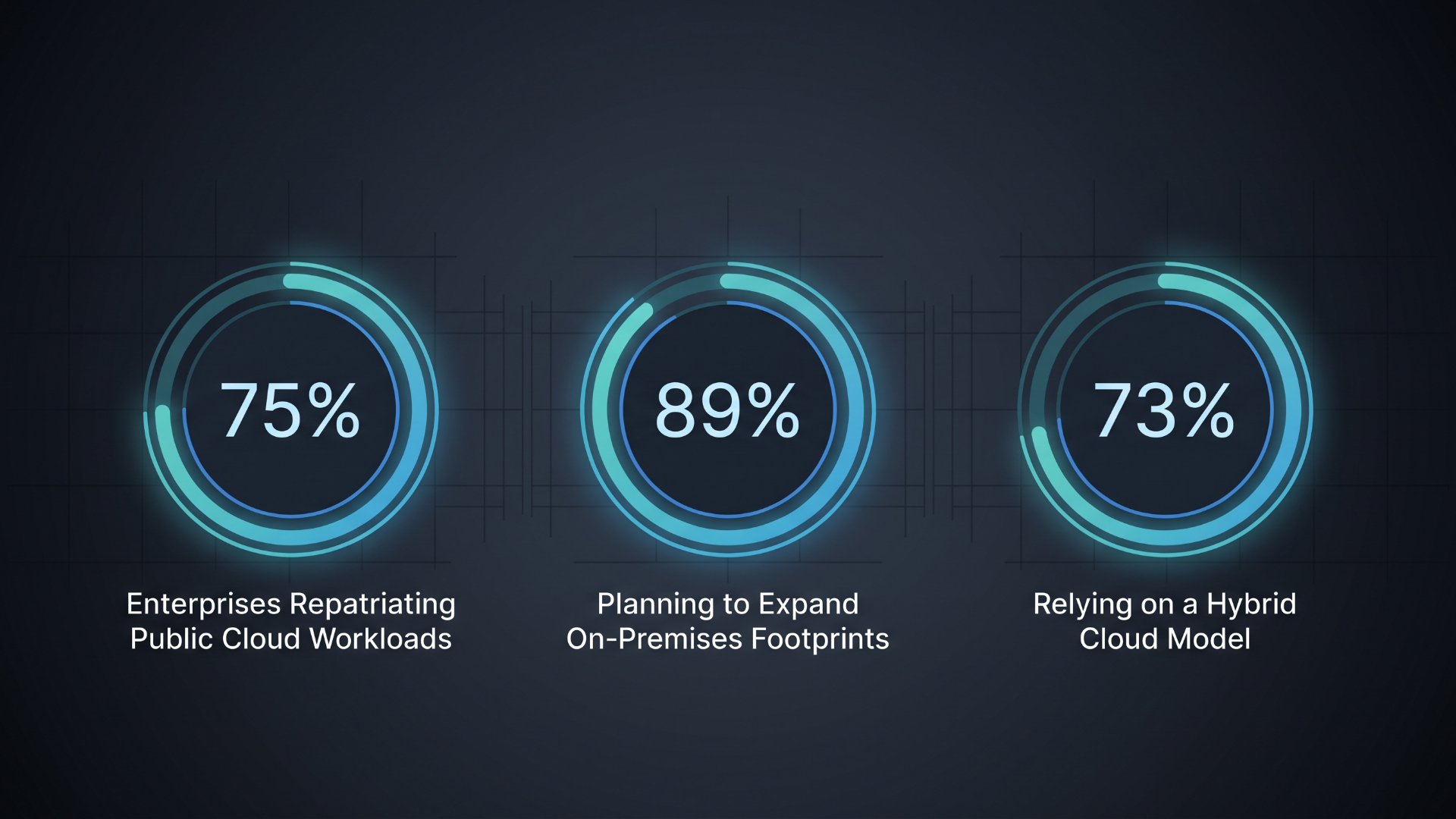
Cloudian’s hybrid cloud research estimates that 75% of surveyed enterprises had already repatriated workloads from the public cloud, while 89% planned to expand their on-premises footprint. Similarly, Flexera’s 2026 State of the Cloud Report estimates that 73% of enterprises now rely on a hybrid model; placing workloads wherever they make the most technical and financial sense. For most organizations, the future isn’t exclusively public cloud or exclusively on-premises. It is the freedom to use both. But there is a catch: having the freedom to choose your infrastructure means very little if your workspace software locks you into a single platform.
Your VDI Shouldn’t Dictate Your Infrastructure
Virtual Desktop Infrastructure (VDI) is a prime example of hidden lock-in. Organizations that adopt cloud-native VDI solutions often find themselves tied to the same hyperscaler for both their desktop delivery layer and the underlying compute infrastructure. If costs spike, sovereignty rules tighten, or you decide to move workloads back on-premises, you may be forced to rip and replace your entire virtual workspace stack. Inuvika OVD Enterprise takes a fundamentally different approach. As a hypervisor-agnostic virtual application and desktop delivery platform, Inuvika OVD runs on any hypervisor including VMware vSphere, Nutanix AHV, Proxmox VE, Microsoft Hyper-V, VergeOS, Virtuozzo, Zadara and many more. Organizations can keep their exact same virtual desktop experience while changing the infrastructure underneath; whether they are migrating away from VMware and Microsoft, adopting a sovereign European or Canadian cloud or going back on premises.
Importantly, infrastructure independence is not the same as automatic disaster recovery. True high availability still requires deliberate architecture, redundancy, and recovery planning. What platform independence gives you is something equally strategic: the architectural freedom to diversify providers, control costs, and adapt your infrastructure without being held hostage by your VDI vendor.
Independence Is Becoming a Business Priority
The takeaway from last week’s outage isn’t that businesses should abandon the cloud. It is that relying entirely on a single hyperscaler creates operational and commercial risks that leadership can no longer afford to ignore. With Inuvika OVD Enterprise, organizations separate their virtual desktop strategy from their underlying infrastructure decisions; reducing vendor lock-in while maintaining full control over deployment, sovereignty, and total cost of ownership. The strategic question for IT leaders is no longer simply whether to use the cloud. It is whether you still have the freedom to leave it.
To see how Inuvika OVD Enterprise can help your organization eliminate vendor lock-in and maintain true infrastructure independence, contact our team today.
Sources
- Microsoft hit by global outages: What happened and why?
- Microsoft outage ‘stark reminder’ of how much we rely on tech
- The Commission moves forward on cloud sovereignty with a EUR 180 million tender
- Hybrid Cloud Challenges: Enterprise Guide (2026)
- 2026 State of the Cloud Report
- Inuvika OVD Overview